
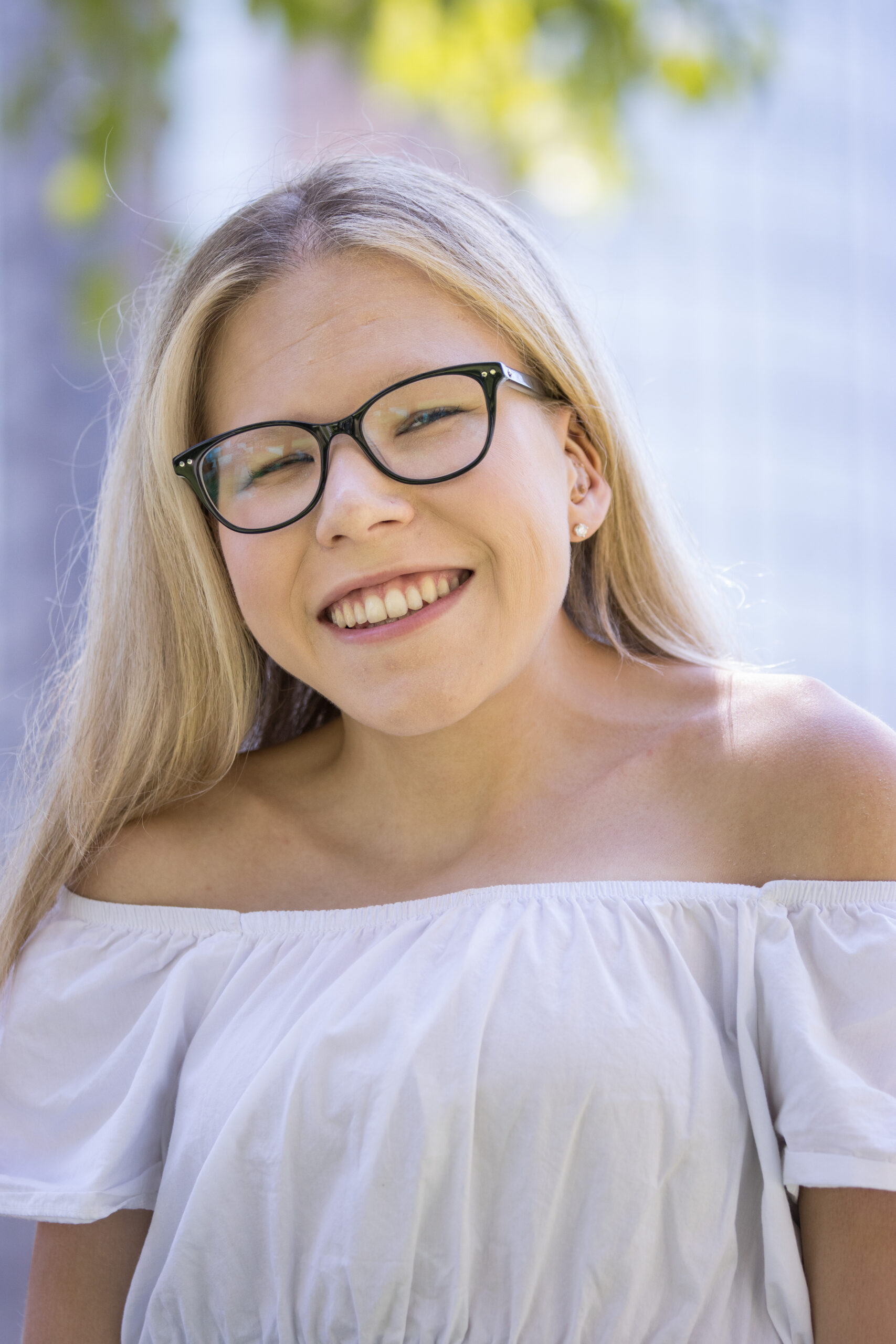
A smiling blonde woman wearing black-framed glasses and a white off-the-shoulder top stands outdoors in soft natural light, with greenery blurred in the background
Starring in a big commercial was never on my bucket list, mostly because I never believed it was something that could happen to me. It felt too distant, too unlikely, especially in my early twenties. Opportunities like this weren’t designed with people like me in mind.
Like many disabled people, I grew up rarely, if ever, seeing myself represented in the media. From a young age, I understood one core truth: the world is not built for me. That lesson came with many difficult realities. There would always be obstacles to navigate, stereotypes to defy, and accommodations I would have to fight for. I never expected the entertainment industry to be any different.
When I moved to Los Angeles at 19 to attend a musical theatre conservatory, that expectation was quickly confirmed. I faced constant inaccessibility with architectural barriers, rigid systems, and assumptions about what my body could or couldn’t do. I encountered stereotypes from peers and teachers alike, and while there were a few other physically disabled students on campus, we were treated as exceptions rather than the norm. None of them were pursuing a program as physically demanding as mine, and the message, spoken or not, was clear: this industry was not built for us.
Even though I was accustomed to isolation going into conservatory, that didn’t make it easier. I eventually found friends who helped me navigate the daily inaccessibility of living in the city, but they couldn’t fully understand what it meant to move through the world as I did. Disability has a way of making you feel both hyper-visible and deeply unseen at the same time.
By the time I was in school, there had been some progress in improving disability representation in the media. Ali Stroker had won her Tony, and CODA had won Best Picture. Disabled creatives were finally being recognized on major stages. And yet, from where I stood, that representation still felt like a small dot on the horizon, one that I was barely inching closer to. Each time I walked into a dance class with my prosthesis, hearing aids, and service dog, only to be stared at like a spectacle, it was hard to believe the needle was actually moving. Representation existed, but it felt conditional – convenient and “inspirational” in ways that left little room for nuance or reality.
I didn’t see myself fitting into that narrow narrative. And I couldn’t help but wonder: if I wasn’t inspirational in the “right way,” where did that leave me?
In my fourth semester of conservatory, something very unexpected happened. I received an email from a performance agency asking to meet with me. At school, we were constantly told that securing representation required relentless outreach, auditions, and rejection. But here was an agent pitching herself to me. I was confused and cautious. My peers weren’t even thinking about agent meetings yet. How was I here? Eventually, I said yes. And that decision changed everything.
Suddenly, I was balancing auditions with classes and getting a real glimpse into the entertainment industry beyond the walls of my conservatory for the first time. I saw behind the curtain, and what I saw was complicated. Ableism was still constant, blatant, and still embedded into the very fibers of the industry. I still encountered barriers, low expectations, and moments where my access needs were treated as inconveniences rather than necessities. Famous actors could demand only green M&M’s in their trailers with no questions asked. But when I asked the set to be wheelchair accessible, I received pushback. Unlike earlier in my training, when I often internalized these experiences, the difference now wasn’t the absence of ableism, but the clarity. I was no longer imagining these barriers or accepting them as personal failures. I could name them for what they were: systemic. And that understanding changed the way I navigated the industry.
Four years later, that journey brought me to the set of an Apple commercial focused on accessibility for college students.
The experience was a breath of fresh air. I wasn’t treated as an afterthought or a symbol. Accessibility wasn’t an add-on; it was foundational. I was not there in spite of my disability, but with it fully acknowledged and respected.
For someone who has spent most of her life bracing for barriers, that mattered more than I can put into words.
Being a part of this project didn’t suddenly erase the inaccessibility and ableism that are deeply woven into the entertainment industry, or the work that remains ahead. But it did offer a glimpse into what is possible when disabled people are included intentionally, thoughtfully, and without condition. It reminded me that representation doesn’t have to be rare or remarkable; it can simply exist.
Sometimes, that quiet progress is the most powerful thing of all.
Cassidy Huff is a disability rights activist, best-selling author, content creator, and actress. Born with Conradi-Hünermann Syndrome, a rare form of dwarfism, Cassidy has dedicated her platform to advocating for accessibility, disability justice, and authentic representation. She is the host of a podcast where she highlights disabled voices and stories, and she creates content across YouTube, TikTok, and other platforms in an effort to educate others about disability and issues that directly affect the community. In addition to her activism, Cassidy is a voice-over artist, public speaker, and passionate storyteller who uses her work to spark change and empower others to embrace their differences.