
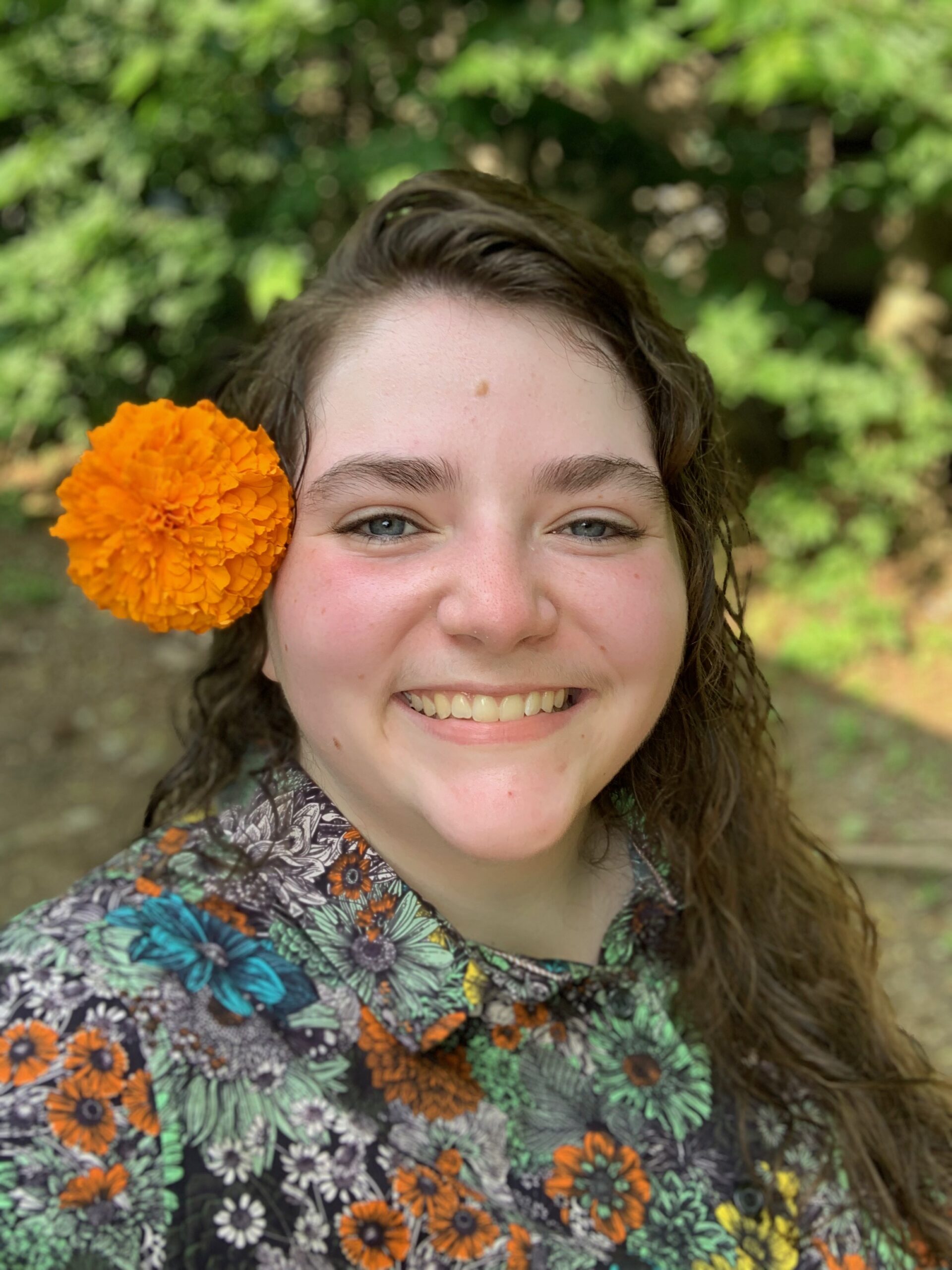
Headshot of a white person with long, brown, wavy hair. They are wearing a multi-colored floral shirt and have a bright orange marigold flower tucked behind their ear.
I often surprise people in my community when I tell them that I don’t drive. They inevitably respond, “Then how did you get here?” While I wish my answer were fast and simple, 9 times out of 10 I end up having to educate my conversation partner about the frustrating, beautiful, and life-sustaining service that is paratransit.
Paratransit is a kind of public transportation for disabled people who can’t use an area’s buses, trains, or other forms of public transportation because of their disability. People can qualify for paratransit for many different reasons, including: a lack of wheelchair accessibility, needing a sighted guide, being unable to wait outside during hot or cold weather, or because the local stations are too far to walk to from their home. Because of the Americans with Disabilities Act, paratransit is legally required in all areas within a ¾-mile of a fixed-route transit system in the United States. It is also a shared system, so a vehicle might pick up and drop off multiple people during the same trip.
I will admit, I did not want to sign up for paratransit service for a long time after learning about the program, even though I was clearly eligible. I associated the accessible minibusses I saw around town with indignity. In car-dependent places, driving is the same as being independent. In our ableist culture, being independent is the most important thing a person can be. To rely so heavily on other people is supposedly a sign of weakness, and to be at the mercy of others to take care of you is scary. Hasn’t everyone read a horror story about ride-shares or unruly passengers on public transportation? And how can a person be in control of their life if they are not in control of their mobility?
The final push that got me to apply for paratransit was learning about disability culture and realizing that no one can ever be in full control of their bodyminds. Once I started using the service, I learned more about disability culture than can ever be learned through books.
Paratransit is immersion into crip time, where the abled standards of what should happen and when it should happen are stretched, shortened, twisted, and destroyed. Crip time can show up in the literal minutes of everyday life. For example, taking paratransit always takes longer than driving. To book a trip, I have to call the reservation center during their business hours and at least a day in advance. I am often early or late to appointments, and I must leave precisely when the bus requires.
Drivers do not wait long for a late rider to appear, about 10 minutes or so, before moving to their next destination. But between late riders, unexpected traffic, and loading time, the minutes can quickly multiply into a problem. If I’m late, it could mean another rider misses an important medical appointment or gets their last strike for being late to work. So my day-to-day schedule is largely dictated by paratransit, a particular disabled experience.
But crip time also affects the shape of an entire life.
I did not get my driver’s license at 16, and I will never buy my first car. These accomplishments are cultural milestones that mark a successful transition into adulthood. Those of us who never complete these symbolic achievements face an infrastructure that does not account for our existence. But in our negation of the norm, we can create something new.
In my case, taking paratransit instead of driving feels like a rebellion against a culture that values people based on how much money they can make. We are constantly encouraged to be fast, agile, and productive, no matter the personal cost or limitations. So to slow down is to say my worth comes from being a human being, not from dollars.
I have also found myself recognizing and craving interdependence. Every person is reliant on other people; the amount of help we need is different from person to person, but no one gets through this life alone.
As many public health officials have attested, we are living through a loneliness epidemic. But because I need help getting around, I know more of my neighbors than I ever would have otherwise. There are dozens of bus drivers, call center workers, and mechanics who get paid precisely because I and others need their help. Generations of advocates fought for my right to receive help, and I will not reject their gift.
I do not worry so much about the clock when I am staring out the window of the paratransit bus, which is several feet taller than a car. The city I have lived in my whole life looks more connected from up here.
Melina List (they/them) is a writer, artist, and communications specialist from Nipmuc and Massachusett land. They are the founder of the Framingham Disability Cultural Series.