
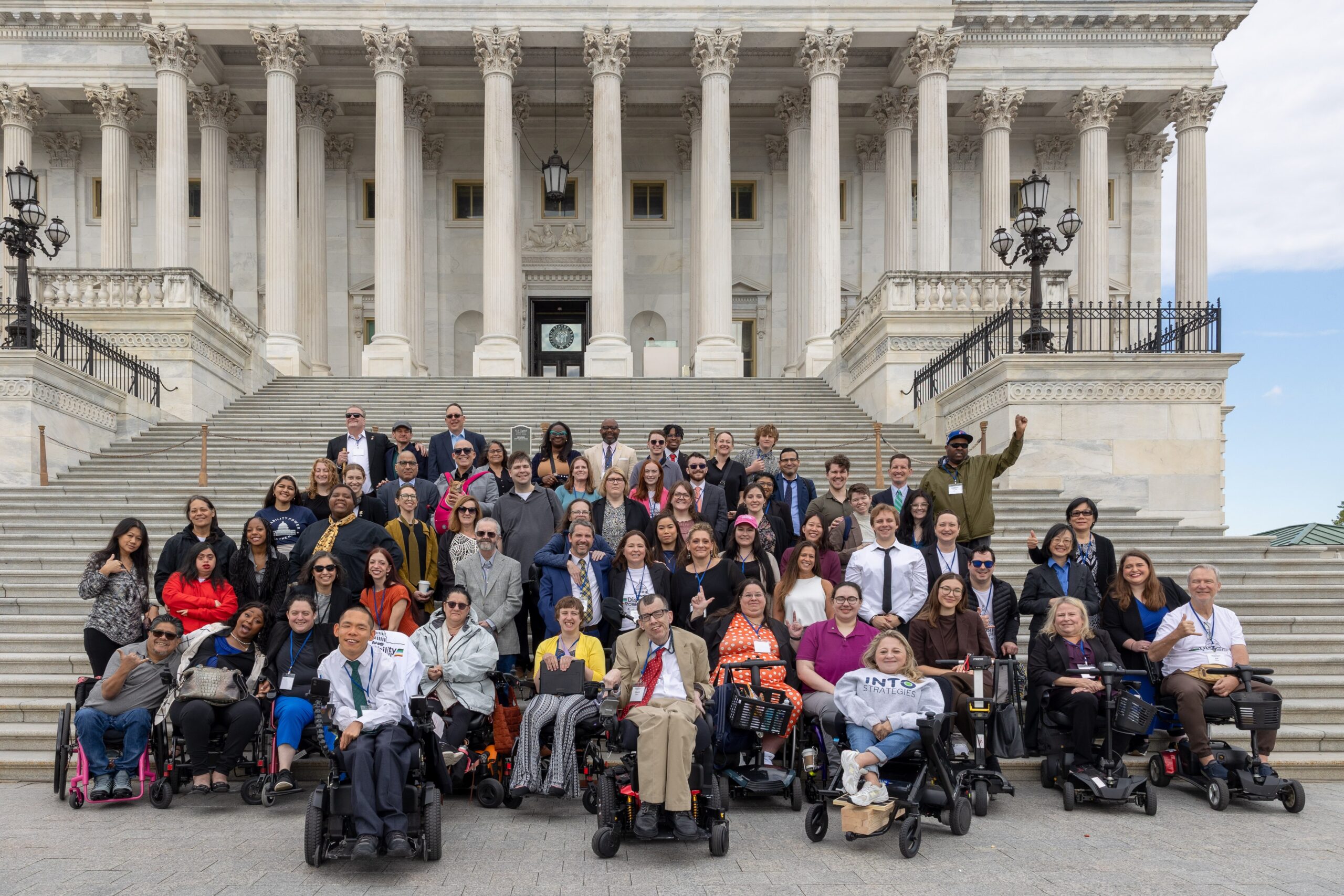
AAPD staff and advocates posing in front of the US Capitol building
From May 11-15, the American Association of People with Disabilities (AAPD) hosted its 3rd annual Disability Power on the Hill event. 72 disability advocates came to Washington, D.C. from states all over the country. These advocates did 75 meetings on Capitol Hill, 15 of which were with a Representative or Senator. Since this event, there have been at least four new cosponsors on AAPD priority legislation.
We asked four participants to write about their experiences attending Disability Power on the Hill and what they learned about themselves and their advocacy power. Read their reflections below:
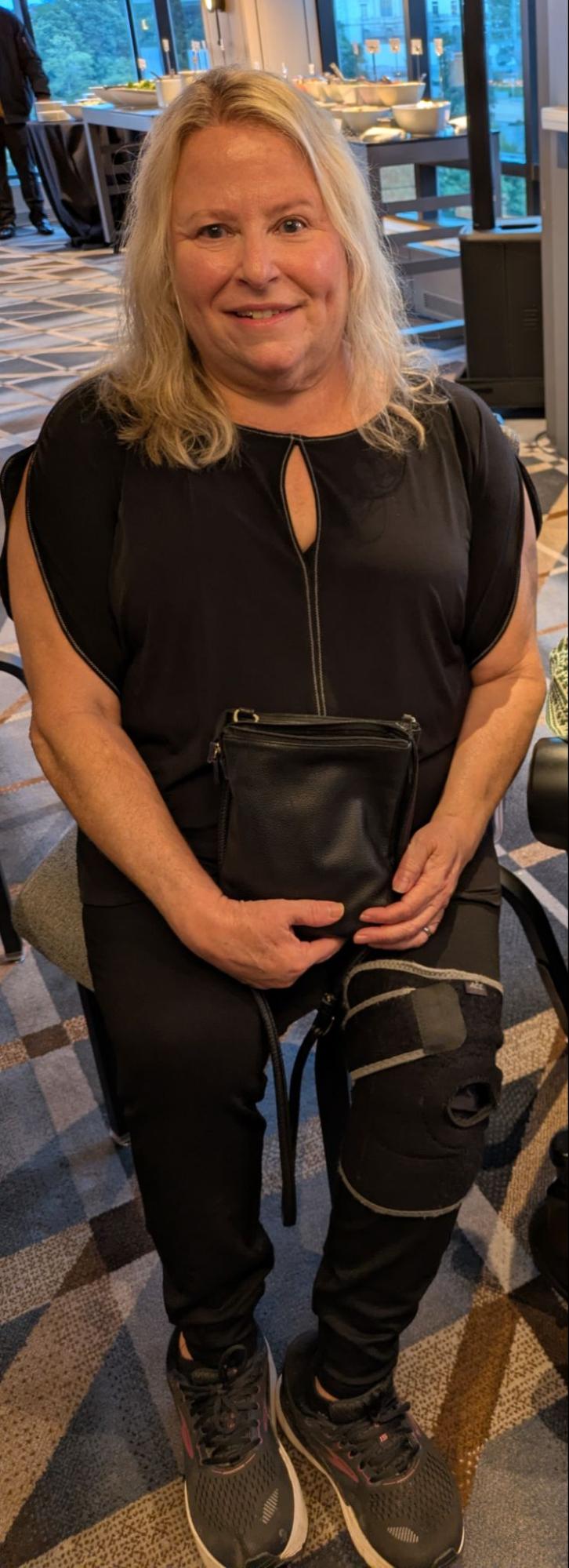
A woman with blonde hair and black clothes smiling
Tina Argetsinger
May was my third time having the honor of attending AAPD’s “Disability Power on the Hill” event, flying in from Oregon with my manual wheelchair and my son as my assistant for the second time.
Each time I enter the hotel conference room on the first morning, I feel like Alice in “Through the Looking-Glass,” entering a world reversed from ours — one made for people with disabilities. Inside, a large rainbow of people with a variety of disabilities fills the room. Some disabilities are visible; some are not. Some, like mine, are congenital, while many are acquired later in life due to an accident, stroke, or disease. Others have multiple disabilities, adding to the diversity of our community.
We span ages and backgrounds, each with unique stories that demonstrate how disability intersects with race, ethnicity, gender, sexual orientation, income, and social status, connecting us through our shared experiences. Together, we represent rural and urban areas from many states: as far away as Hawaii in the west, Louisiana in the south, Pennsylvania in the east, Vermont in the north, and others such as Montana, Tennessee, Oklahoma, and Wyoming.
All our various access needs have been accommodated by dedicated AAPD staff, making us feel welcome and valued. When we meet with members of Congress, we join our state cohorts and adventure the halls together — with our wheelchairs, scooters, white canes, assistants, ASL interpreters, and Deafblind interpreters.
With a seat at the table, we urge members to protect Medicaid and Home and Community-Based Services (HCBS), and to cosponsor and pass the IDEA Full Funding Act and the SSI Savings Penalty Elimination Act. We share our stories to illustrate why these measures must be enacted to safeguard the future and dignity of our community. Our confidence grows with each meeting, as we listen and learn from one another.
For me, it’s a bit like home week, seeing policymakers and staffers that I’ve built relationships with over the past few years. When I return home to the real world, the experience often feels like a dream, but its impact remains tangible. That week shows us what’s possible and the real power and influence of our community when we come together across different disabilities, political differences, and other facets of marginalization and privilege, and unite on policy issues that we can all relate to.
Born with Osteogenesis Imperfecta (“Brittle Bone Disease”), Tina is a lifelong advocate for herself, her neurodivergent son, and her aging parents and in-laws. In the early 2000s, she joined a landmark lawsuit against Regal Cinemas that established new federal accessibility rules for wheelchair seating in stadium-riser theaters. After a career in marketing communications, the Syrian War in 2015 inspired a turning point: reflecting on the plight of disabled individuals during wartime, she pivoted to writing a novel and expanding her advocacy to include both disability and immigrant/refugee rights.
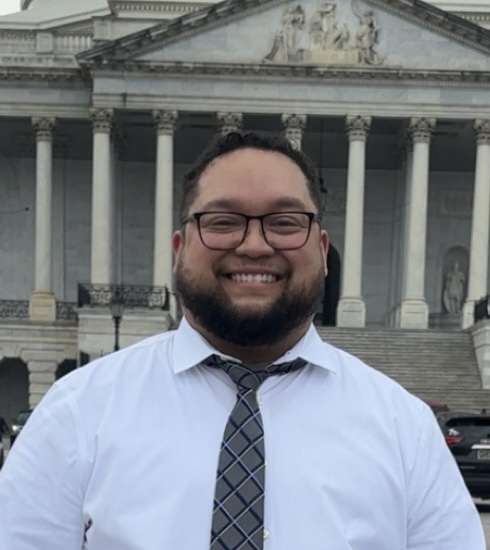
A man wearing a button-down shirt and tie smiling.
Brandon Connolly
Walking the halls of the Capitol during Hill Week, I kept thinking about home. Among the suits, I showed up as myself: a community organizer from a small Idaho city, representing people who rarely have a seat at these tables. And that reminder carried me through the week. That’s exactly why I was there. And across the country, people are doing this same work in their own communities, navigating the same tensions, fighting for the same right to be seen and understood. That’s also what made connecting with other advocates so meaningful.
Even more so, I worked with an amazing team of other Idahoans from across the state, who I had the pleasure to meet and work with for the first time. Our meetings with Idaho’s members of Congress centered on preserving Medicaid, keeping healthcare providers in Idaho, supporting the Individuals with Disability Education Act (IDEA), and updating Supplemental Security Income (SSI) laws. What struck me most wasn’t the policy complexity or needing to know the ins and outs of politics. It was how much a single, specific story could shift the energy in a room. Staffers and legislators hear statistics constantly, and at first I thought that’s what I needed to get through to them. But what cut through and shifted their attention was saying: This is what my community needs. This is what your choices in D.C. look like in Idaho.
I left D.C. more committed to this work than when I arrived. What I didn’t expect was how much I needed the reminder that we’re not doing this alone. Disability advocates are out there everywhere, in every state, utilizing their knowledge and lived experience to create a more accessible and just world. What a joy to have been part of that kind of power on Capitol Hill.
Brandon Connolly is an Idaho-raised, longtime community organizer whose work centers around the intersections of racial justice, gender justice, LGBTQIA+ rights, and disability rights.
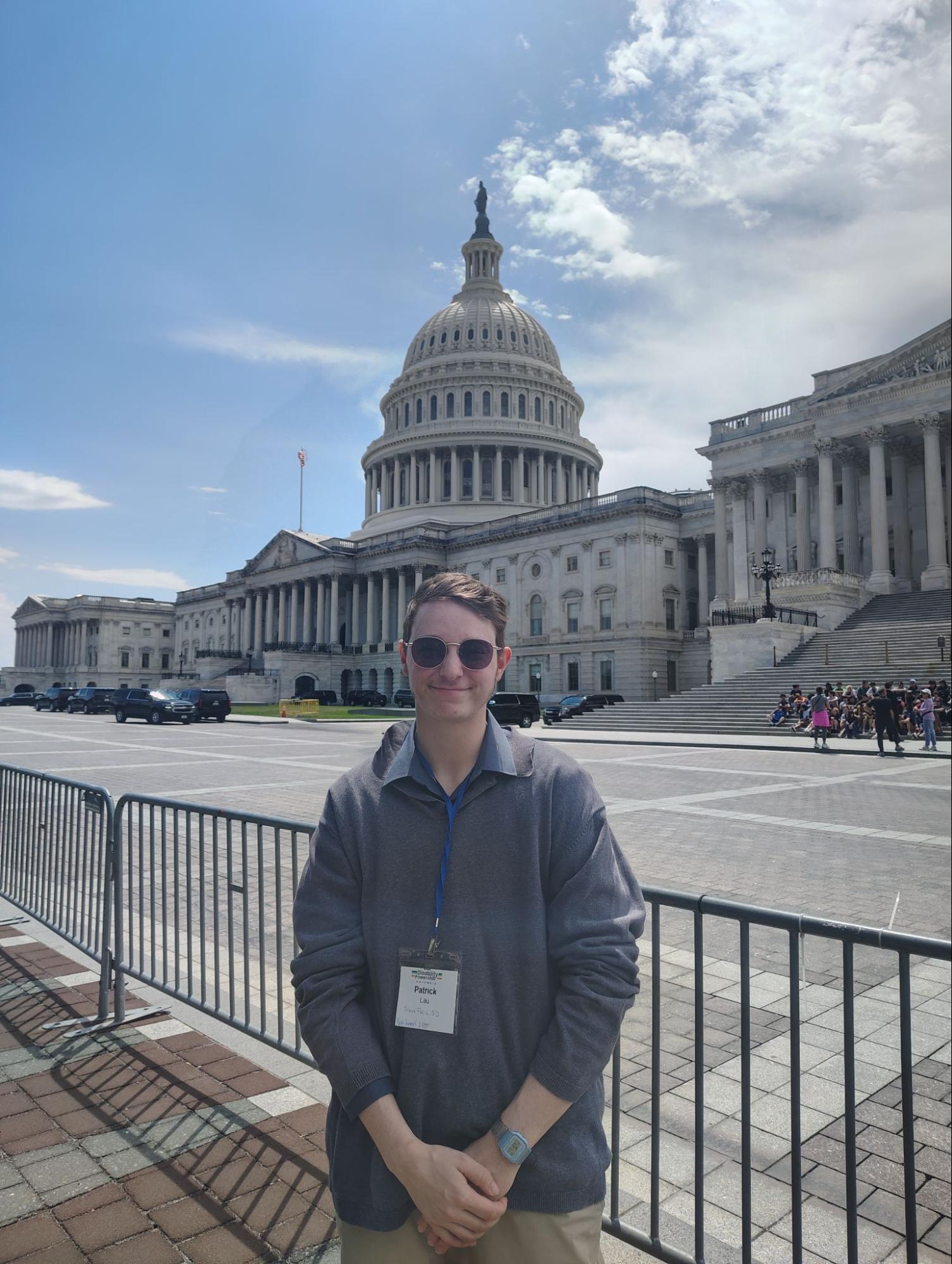
A person smiling in front of the Capitol wearing a button-down shirt and sunglasses
Patrick Moody
AAPD’s 3rd annual Disability Power on the Hill 2026 was an amazing experience that I will never forget that ignited an advocacy fire within me to learn and grow as much as I can! I had the honor of advocating for the disabled community of South Dakota and speaking to members of Congress and their staff about issues that impact the disabled community. This is the first time I have ever done advocacy on this scale and it taught me a lot about myself, my disabilities, my rights and how I can help advocate for my community. As an RBT (Registered Behavioral Technician) who works with children on the Autism spectrum, and as youth support staff at an LGBTQ+ Center who sees and works with many neurodivergent and disabled youths aged 4-18, I want to do whatever I can to advocate for them. This opportunity opened my eyes to the possibilities I have to do that for them.
This experience taught me many things about myself and my limits. I never thought I would ever talk to a member of any level of government let alone members of Congress. I was still extremely nervous but I reminded myself when I was most anxious that I am fortunate enough to speak out and advocate for those who may not be able to for various reasons. This is bigger than me and I am NOT alone. All of the advocates who showed up from across the country showed me that I was welcome and they taught me a lot. I cannot wait to share all of the knowledge that I learned from Hill Week and continue to advocate for my community.
Patrick Moody is from Sioux Falls, SD. He is an adult with Autism and ADHD. He works as a RBT for children with autism and Youth Support Staff for the Transformation Project working with transgender youths. He is an advocate for disability and LGBTQ+ rights.
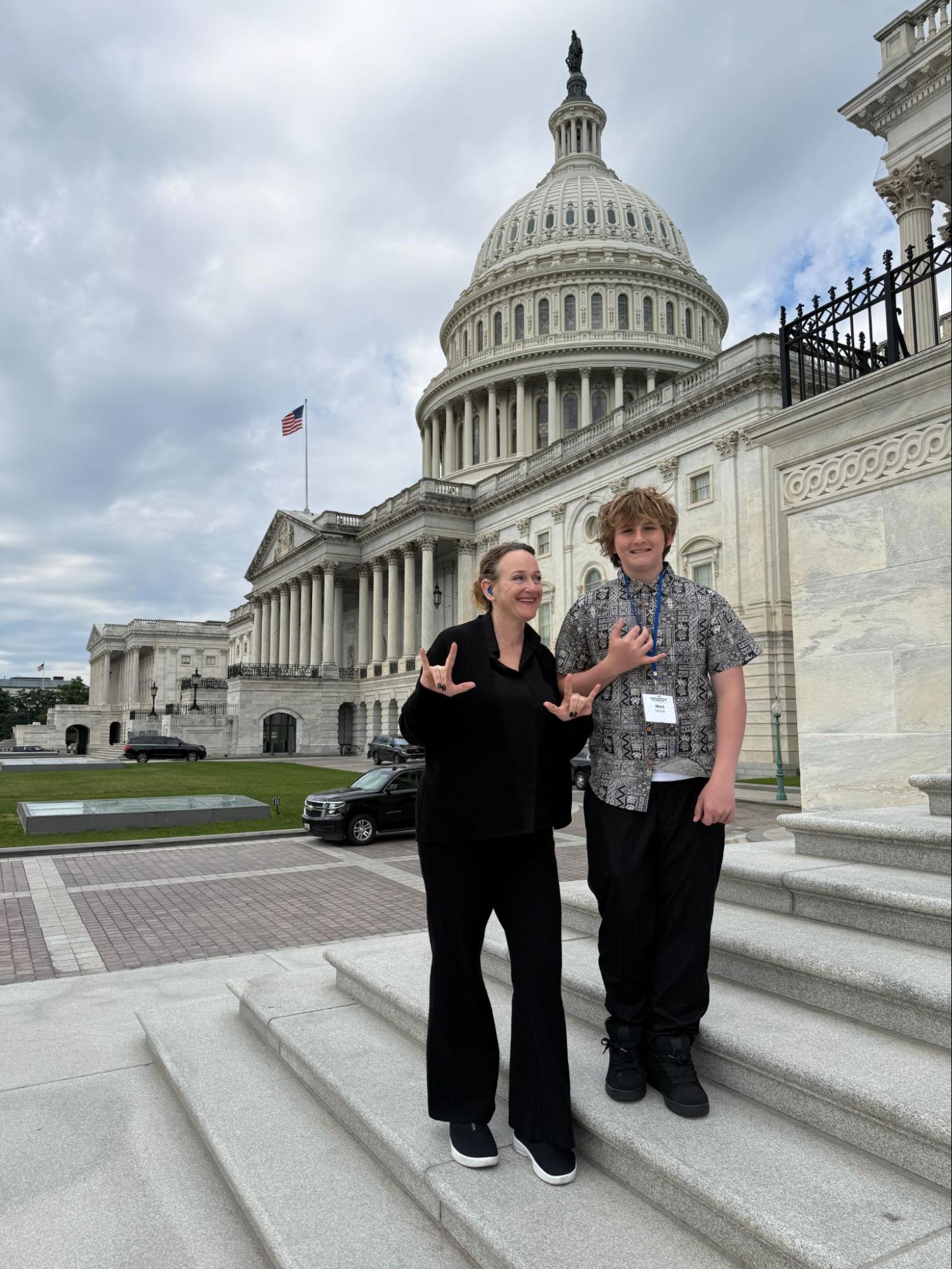
Meriah and her son at the Capitol
Meriah Nichols
Disability Power on the Hill brought the cross-disability community together with a clear purpose: advocating for specific bills and one significant protection that matters deeply to all of us. It was a diverse collective gathering. It was highly focused, engaging, and organized. It felt powerful and joyful.
For me, it also felt like an awakening.
During Disability Power on the Hill, I watched my youngest child, a neurodivergent 7th grader, step into disability advocacy for the first time. He came with stories of his own: real, first-hand accounts of inaccessibility and injustice at his school. When he shared his stories with Representative Tokuda, she asked him to send her his account in writing and, on the spot, committed to making change at his school.
My son has grown up watching his older sister, who has Down syndrome, and his older brother, who is autistic, become involved in advocacy projects for our community time and again. This was his first time, and in those days on the Hill, he had the full support and encouragement of his Hawai’i disability ‘ohana. They lifted him up and invited him to share. They listened to him with love and support. Through this, I saw something shift in him: a recognition of his community, his place in it, and the power of his own voice.
That’s what disability advocacy looks like when it’s intergenerational. That’s what it looks like when it’s our village working together. And that’s what it looks like when it works.
Meriah Nichols, MMIM, MA, LMHC, is a deaf, neurodivergent mental health therapist, teacher, writer, mother and disability justice advocate based in Hawai’i. With decades of experience working across disability, education, and career development sectors, Meriah brings a cross-cultural, trauma-informed, and neurodivergent-affirming lens to her work. You can find her at Unpacking Disability with Meriah Nichols (meriahnichols.com)