
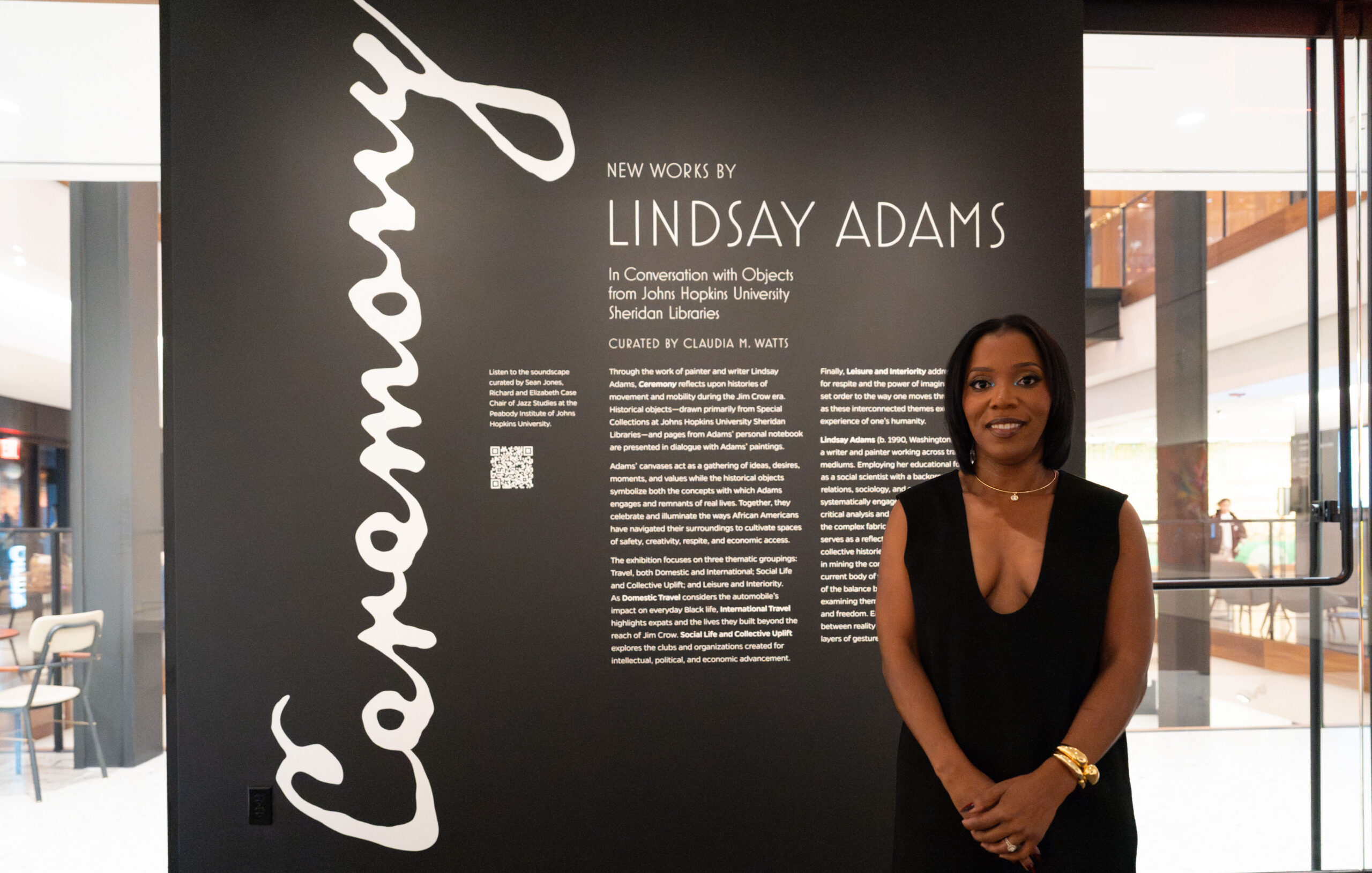
Lindsay Adams standing in front of a wall detailing her exhibit called “Ceremony.” She’s wearing a black dress and gold jewelry.
Black History Month offers a moment to reflect on the people whose creativity, resilience, and leadership continue to shape our shared future. At AAPD, we are proud to highlight Black disabled artist Lindsay Adams, whose work explores memory, belonging, movement, and the experience of navigating a world that is not always built with access in mind. Through painting and reflection, she invites viewers to consider what it means to gather, to persist, and to be seen on one’s own terms.
As her work reaches wider audiences, including a solo exhibition in New York and placement in the Obama Presidential Center, Adams offers a powerful example of how art can deepen understanding and strengthen community. In this Q&A chat, she reflects on identity, disability, intersectionality, justice, creativity, and what it feels like to share your voice when others are truly listening.
Lindsay Adams’ reflections remind us that history is not only something we look back on. It is something we shape in real time through art, dialogue, community, and lived experience. She speaks about her work as a way to document this moment and contribute to a larger conversation about belonging, access, and how people gather across time and place.
As we mark Black History Month, Adams’ perspective encourages us to listen carefully and make room for nuance and multiple truths. She invites us to recognize the many ways disabled people – especially Black disabled people – are shaping culture, community, and public life right now.
Adams recently gave AAPD staff a personal tour of her exhibit, Ceremony. Afterwards, AAPD had the opportunity to interview her. Ceremony is on display at the Johns Hopkins University Irene and Richard Frary Gallery in Washington, D.C. through March 7.
We are grateful to Lindsay Adams for sharing her insights, creativity, and vision, and we hope her work invites readers to continue engaging with these conversations long after this month ends.
Below is our Q&A with Lindsay Adams.
Q: What inspired you to become an artist, and how did you find your creative voice?
I think I wouldn’t say there was one definitive inspiration point for becoming an artist. It’s something I have lived with for a very long time, even before I knew what it meant to be an artist. Art was always present in both the background and the foreground of my life from a relatively young age. It was a form of release for me and a form of expression early on. I continued with it academically, learning and receiving formal and classical education in painting and drawing.
I continued through undergrad, where I received a minor in studio art alongside my majors in international studies and Spanish, and then ultimately I received my MFA last year. I would say the definitive jump to pursue this professionally happened about five years ago, and it has been both a joy and a challenge navigating my different careers.
I mentioned on Friday that my work used to be mainly reference-based. I would paint scenes of flora, not quite landscapes but more like moments of blooming, based on photos I took while traveling or at home. I also painted women who were often imagined with different reference materials and ideas. At that point, the substance of my work focused on land and place, thinking about flora as a motif for land and interrogating the Black ancestral connection to it, along with beauty and environment.
Over the years, my painting practice has become equally a formal and technical exploration as it is conceptual. I think more about imagination and memory now, and about building worlds through color and mark-making. That is something I have continued to develop and am still developing, specifically through the lens of abstraction.
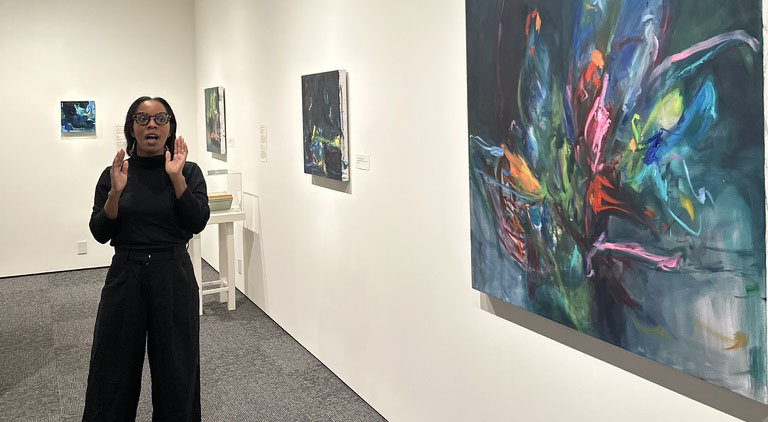
ID: Lindsay Adams speaks next to one of her paintings called “Lotus Blossom”. The painting features many colors on a primarily blue background. The painting looks like a lotus flower blossoming.
Q: What is the significance of your Ceremony exhibit on display right now?
Ceremony is my first institutional exhibition, and it is also my first return home with my work since moving to Chicago. I am very grateful for the opportunity to have worked with Caitlin at the Frary Gallery and to have this curatorial partnership with Claudia, someone I have been in community with for the past few years. We have both continued to grow my painting practice and her curatorial practice.
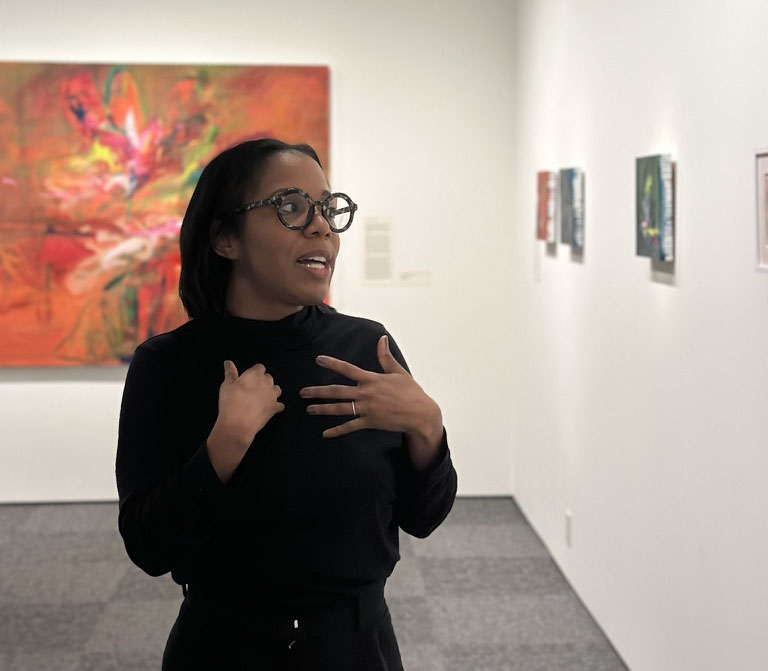
Lindsay discussing her art in front of a large orange painting called Solar Searching.
For this exhibition, we came together around ideas that were important to us. We engaged the archive at the Johns Hopkins Special Collections.
Ceremony represents a conversation between my painting and drawing practice and these archival documents, exploring themes of belonging, community, and what it means to gather. The exhibition itself becomes a place of gathering. Viewers can feel the movement of my mark-making and color while also seeing the ways Black Americans have gathered domestically and internationally through travel and movement.
Q: Is there a particular work you are most proud of, and what makes it significant to you?
I would not say I have one work I am most proud of. I really enjoy all the works in the show, but I especially appreciate the series of smaller paintings I described, the “Where Can I Go to Frolic?” series, and the larger orange painting, Solar Searching.
I am quite proud of Solar Searching because it is a very striking painting in terms of color. I often lean into warmer hues, and that piece has this dynamic burst of energy and light. It kind of unfolded quite beautifully as I worked on it. So between Solar Searching and the series connected to “Where Can I Go to Frolic?”, those are definitely works I feel especially proud of.
Q: Can you share a little about your disability journey and how it has shaped your life and work?
I was born with a disability, so it was not the result of an accident or something that happened later in life. It is something I have had to manage and navigate for over three decades. I was born with cerebral palsy, and my relationship with it has been complex.
I always knew I was different and felt a sense of otherness because of it. For a long time, it was not something I talked about much. I was still figuring out what it meant and how it impacted me. As I got older, it became harder for other people to recognize or understand, so when I brought it up there was often this dissonance, people saying they did not know or did not see me that way. But whether people see it or not, it is a real part of me that I have to navigate. Even when I am able-passing, as I call it, it is still something I am always considering.
My speech is much clearer (which has taken time and practice), so communication barriers are not what they once were, which makes it easier to explain myself verbally. But there are still many nuances and frustrations, including physical limitations and the fact that it is not something I can turn off. Because I was born “other,” I cannot set that perspective aside, no matter how much access I have.
Living with a disability has given me a deep level of empathy and understanding, even though it can be frustrating not to be considered in the same way as others. I tend to think about things in nuanced ways because I have had to. It is difficult to separate disability from who I am. It is not something I can hang up like a jacket. I feel it more strongly in some contexts than in others.
I am much more comfortable with it now than I was when I was younger. I would not say I have a perfect grasp of it, but I have a solid understanding of how it impacts me and how it shapes the way I see the world.
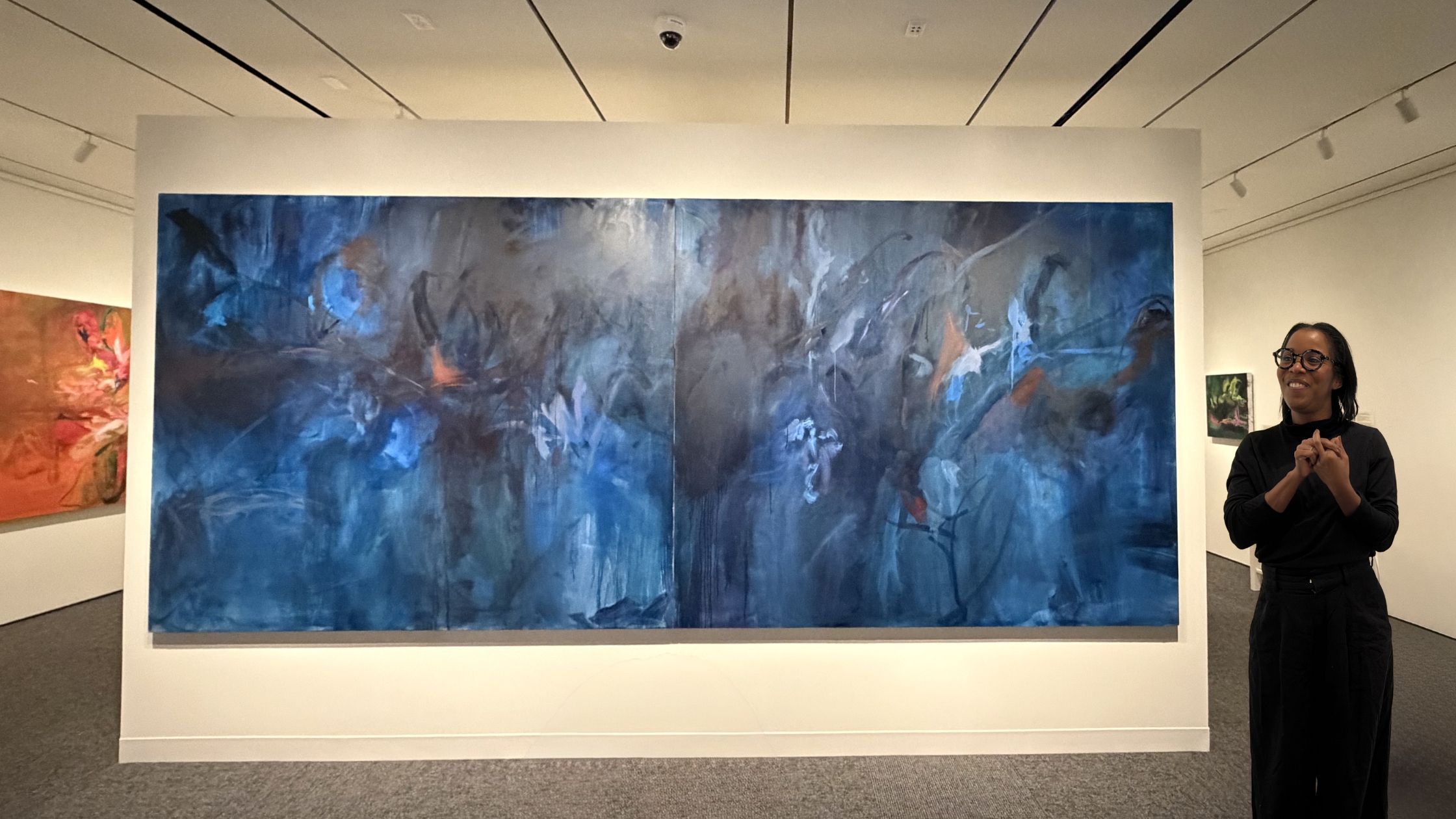
Lindsay Adams smiles while speaking next to one of her paintings called “Kind of Blue.” The painting is large and takes up the entire wall that it is on. The painting features a blue and black motif, with small highlights of red throughout.
Q: How does your intersectional identity of being a Black disabled woman influence your perspective and your art?
W.E.B. Du Bois introduced the concept of double consciousness, and later feminist frameworks expanded that idea to include the experience of Black womanhood. As a Black disabled woman, there is another level of consciousness layered onto that experience.
There is an additional awareness I carry about who I am and how I show up in the world. It is somewhat like a Venn diagram. There is a lot of overlap among these identities, including shared challenges, but disability adds another dimension.
Disability introduces another perspective on what it means to persevere within systems that were not designed for you. Within laws, infrastructure, and social biases, there are many barriers. That perspective motivates me to push for environments that are more equitable and accessible.
Access looks different when you live at multiple intersections. It raises deeper questions about what an equitable environment truly looks like in a holistic sense.
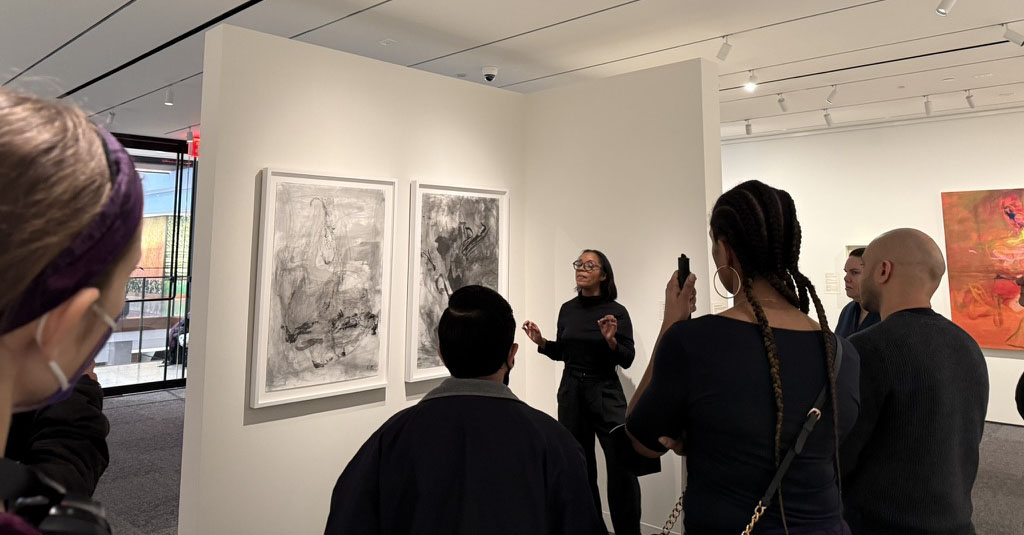
Lindsay Adams speaks to AAPD staff about her art. She’s standing in front of two untitled black-and-white works of art.
Q: What motivates your advocacy for disability justice, and what changes do you hope to see?
I do not believe in policing how individuals relate to or speak about their disability. It is complex and shows up differently for everyone. Each person’s relationship to it and what they choose to share is their decision. Advocacy can be exhausting, and not everyone has the capacity for it. Fortunately, the community is broad enough that some of us can take on that work when we are able.
Part of my motivation comes from recognizing that people listen to me when I speak. Because of that, I feel a responsibility to be thoughtful about what I say and how I say it. Not everyone has a platform or an audience willing to listen, and I have been fortunate to be surrounded by people and organizations that are open to these conversations.
That led me to ask myself, what do I want to say if people are listening? How can I use my voice, one I struggled to accept, in a meaningful way? In many ways, it felt like filling a gap and expanding understanding.
Advocacy is my form of protest. I may not always be able to be on the front lines physically, but speaking out is a way of making clear that disabled people are here and part of the broader human conversation.
There are many changes needed, from legislative accessibility to local implementation, as well as addressing stigma and expanding public understanding. The first step is making sure disability is not ignored or treated as an afterthought.
Q: Are there any current or emerging disabled artists who have caught your attention, and do you have advice for other disabled artists?
I have a dear friend and colleague I met at the School of the Art Institute of Chicago, Isaac Armendariz, who has a dynamic painting and writing practice that has explored his realities of living as visually impaired. He is both a wonderful philosopher and artist who works across abstraction. Howardena Pindell, who is one of my favorite artists, is a person I listen to and watch often. She is also a Black woman who has been living with a disability and has continued to make work that mines history and addresses political and social issues through abstractions and figuration.
My art community has largely formed through the places I have lived and studied. Many artists I know live with disabilities, but their approaches to identity are not uniform.
My advice to disabled artists would be that your voice is important. The art world already has significant access challenges, but sharing your experiences can make the community richer and more dynamic. If you want to share that part of yourself through your work, you should feel empowered to do so.
Q: As you look ahead, what are you most excited about personally or professionally?
In the coming months, I will have both my first New York solo show and work featured in the Obama Presidential Center. These projects represent a moment when my work is reaching very wide audiences. For an artist, it is incredibly exciting to know that your work will live in places and be seen by people you may never meet.
Having work in the Obama Presidential Center also means it becomes part of a permanent legacy. In that sense, the work will outlive me. The idea that it will move through space and time and exist within multiple conversations is very exciting. It feels like being projected into the future.
Artists are, in many ways, living archives of the present moment. The work I create now may help future audiences understand what this time felt like, what was beautiful, what was difficult, and how people were thinking about place, memory, movement, and freedom from constraint. My work may offer context for what it meant to live in this era.
Q: Is there anything else you’d like to add?
I would like to express gratitude for this space and the opportunity to have this conversation about my work with openness while also honoring the importance of this perspective. Thank you for allowing me to share the nuance and layers of my experience, the ways I live through them and paint through them. I truly appreciate the opportunity.