
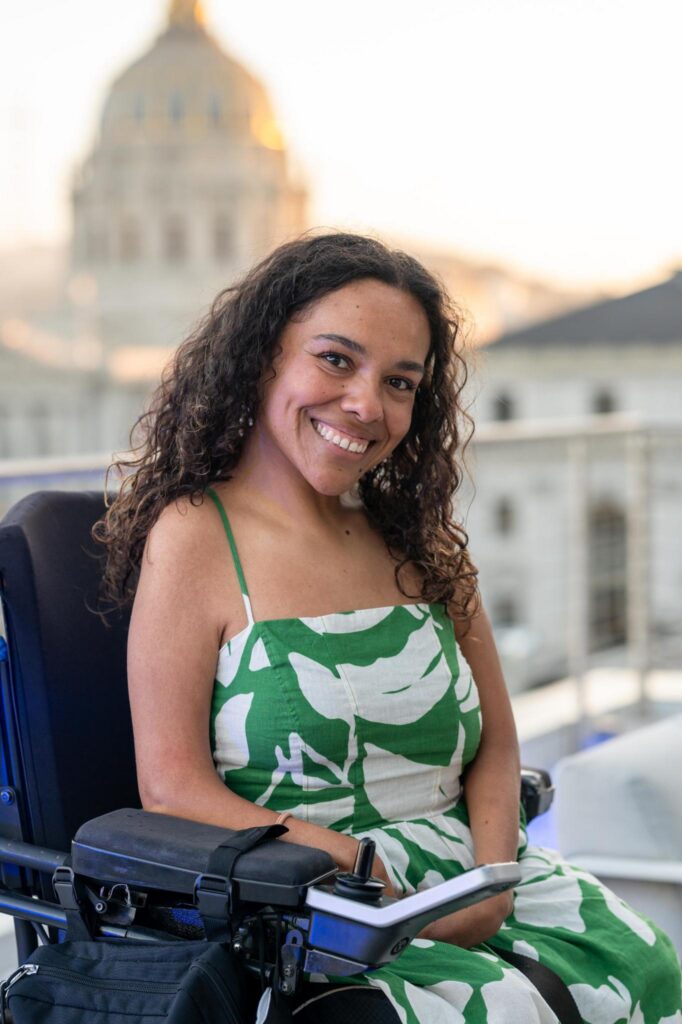
Brittanie Hernandez-Wilson
Brittanie Hernandez-Wilson, one of the recipients of the American Association of People with Disabilities (AAPD)’s 2026 Paul G. Hearne Emerging Leader Award, knows what it’s like to see change in action.
Hernandez-Wilson used her award to fund the initiative Our Stories, Our Care, which supports disabled Californians in sharing their stories to advocate for their rights. When explaining the impact of Our Stories, Our Care, her face lit up as she described how her project changed a participant’s perspective on their own personal power and story.
“For the first time, they were able to speak to legislators and to tell their story. I could just see how empowering it is and how much it changed their life and their view of what they could do and their view of their own power. There is nothing more exciting to me, and it’s truly an honor to be a part of that in any way,” she said.
Hernandez-Wilson is making a difference in the California disability advocacy space, the national fight to Protect Medicaid, and the lives of the disabled people she works with through her project, Our Stories, Our Care. As a longtime disability justice advocate and the California Lead Homecare Organizer at Hand in Hand: The Domestic Employers Network, Hernandez-Wilson realized there was an opportunity to create an accessible space for her local community that is dedicated to using storytelling as a tool for advocacy.
“I just felt in my heart that something that California was really missing was a space for people who had all types of experience, from absolutely nothing, to being in this for years and decades. Folks needed a place where they could go, where they could feel welcome, where they could have accessible everything, and where we could be in community to learn about how our stories can be impactful, and to go through it bit by bit,” she said.
As California deliberated policies that would have negatively affected Medi-Cal and in-home supportive services, Our Stories, Our Care and the LTSS4All Grassroots Coalition — whose storytellers Hernandez-Wilson helped mobilize — showed up. The programs held 11 virtual action hours this year, generated almost 1,000 phone calls to legislative offices, and helped mobilize more than 70 people to attend six rallies and press conferences. Hernandez-Wilson hosted three storytelling trainings with over 95 people in attendance, and the number of people Our Stories, Our Care has trained will only continue to grow.
Thanks to the phenomenal advocacy by Hernandez-Wilson and many other disability advocates in California, the California legislature rejected all of the major cuts to in-home supportive services.
“We did so much, and I think that the proof is in the fact that they again were able to prevent all of those major cuts,” Hernandez-Wilson said. “But we do know that it really is only a breath, and that we’ll be here again next year doing similar things, fighting for our right to live in our community and to receive care in our homes.”
Hernandez-Wilson believes that the advocacy trainings she has facilitated greatly benefit the individuals who participate.
“I know that these folks are going to continue to advocate with us in whatever capacity they’re able to, but that it helps develop their identity, that it helps contribute to their self-concept and their understanding of themselves in a positive way,” Hernandez-Wilson said.
Maya Morya Selkie Scott is one such participant. Hernandez-Wilson worked with them to refine their storytelling skills, and Scott expressed the positive effect Hernandez-Wilson had on them.
“She was really good at bringing out my own words and my own experiences in a way that would emotionally touch the people that were listening,” Scott said.
“She just has a real gift and a very, very deep passionate commitment to access and amplifying the voices and experiences of people and communities that often are disappeared or marginalized even within disabled communities,” Scott continued,
Hernandez-Wilson plans to expand Our Stories, Our Care to make it even more impactful and inclusive, saying, “My hope is that this will continue to snowball, and that the people that were a part of it this year will get even more involved next year in bringing their communities. We also have just a lot more work to do to make sure that we are as intersectional as we can be, that we are really as grassroots as we need to be, and that we’re bringing in people into the fold that are rarely heard or seen.”
“There’s nothing more powerful than using your real lived experience to make people understand that the pen that they’re using to sign can greatly impact your life, can change your life, can make or break your life, can make or break the opportunities that you have.”
Hernandez-Wilson is humble and sincere, even as she described the tangible impacts she and Our Stories, Our Care have had in the last year. She expressed that she cannot do this work alone. Instead, her work is part of a collective movement.
“Although my name is recognized as one of the winners this year, along with Katie, it’s not just about me. This is about our whole entire community. This is about stewarding people into the legislative process and about teaching them how to share the most impactful parts of their story to really change legislation,” Hernandez-Wilson said.
Receiving the Hearne award is a recommitment of Hernandez-Wilson’s advocacy efforts rather than a capstone. What she’s most focused on right now is continuing this important work, with her community right alongside her:
“Because of what’s happening nationally with H.R. 1 being passed, with the attacks on 504 and Olmstead, now more than ever, it’s going to take all of us,” she concluded.