
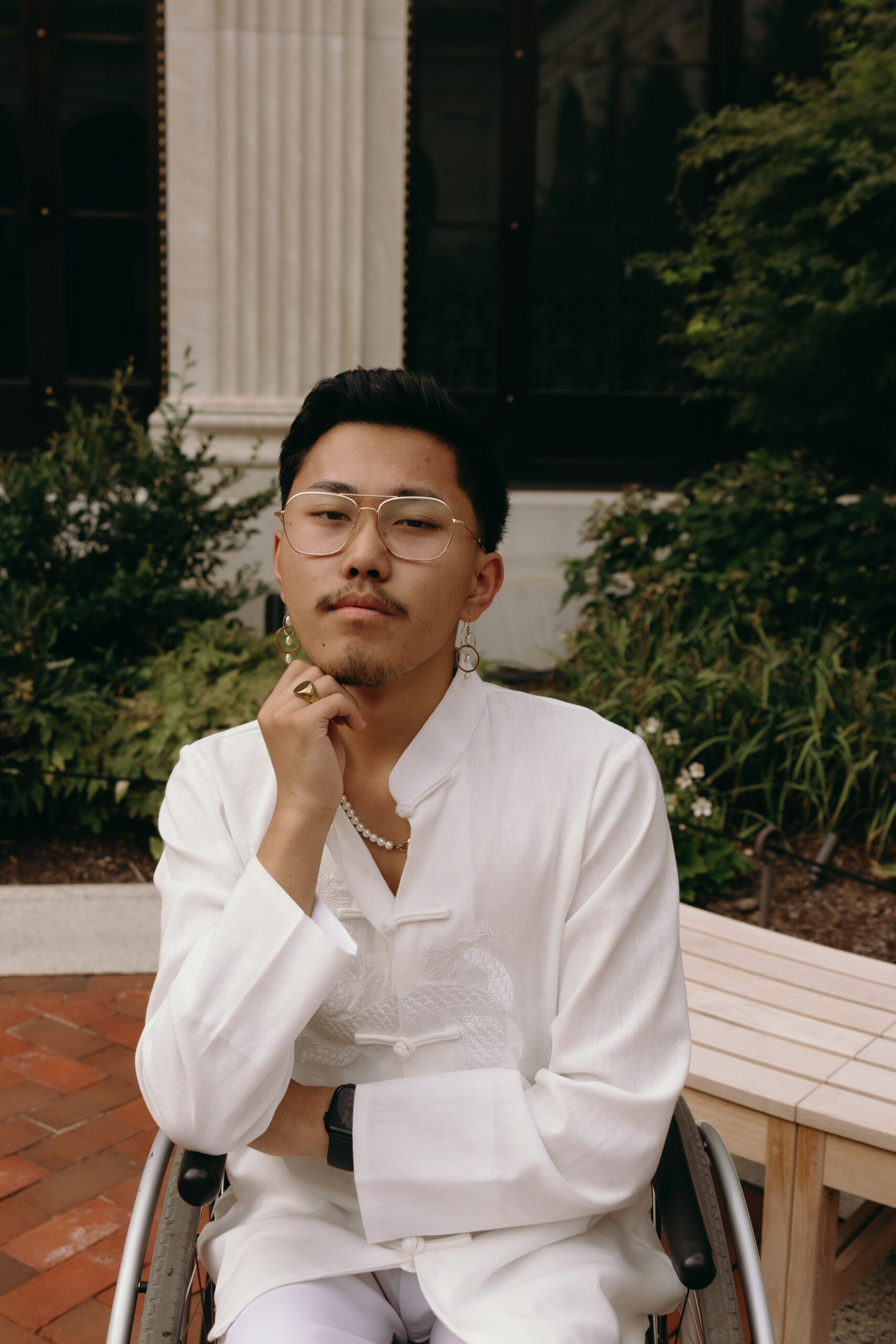
I lay in that hospital bed, thinking, “I am never going to make it out. I am never going to live the life I want.” This idea encapsulated much of my life.
Growing up as a medically complex, Disabled, and international, interracial Chinese adoptee, I spent a significant part of my life trapped by countless grueling surgeries, endless hospital stays, and childhood summers lost to recovery.
In 2007, after adoption and relocation to the United States, I began a long journey of poking, prodding, and stitching by innumerable doctors hoping to fix me, cure me, and reconstruct me. Left in a Chinese hospital for at least 31 days without love, care, or support, the trauma that ensued after adoption was already imprinted at day zero — filling me with fear, anxiety, and mental anguish when I was just a child.
As I’d soon learn, one of my diagnoses was Spina Bifida, or Bifida of the Spine in the translation from Mandarin to English. This would set the stage for a life I had never expected. A life filled with self-catheterization, invasive procedures, medications, IEP/504 plans, and a multitude of others, but most thematically — immersion into a culture that stigmatized disability.
Growing up, I walked unassisted because of the fear of rejection by a society in which I already did not fit in. Everywhere I went, people told me I was “special” and that I was unlike anyone they had seen before. At the time, wanting to fit in was essential, as I wanted to be “normal” because there were no role models — on television or in my vicinity — whom I could see myself and my disability reflected in.
The dozens of gruesome surgical procedures did not help me fit in. Surgery after surgery, on my legs, feet, hip, back, and the list goes on, made me collect new scars — like a child collecting a new Pokémon card, but my collection was less enjoyable. As I maneuvered around the world, strangers would constantly insert themselves into my medical history, approaching me, staring at me, shouting at me, and pointing at me.
As I watched my peers enjoy their summers, mine were spent in a recovery bed filled with sadness, tears, and lost hope. The intense sobs of stagnation filled me as I sat on the toilet, hoping to be rid of that hospital room and its dreary, yellowed walls of emptiness — defecating meant I was one step closer to leaving the hospital as scripted by the doctors.
I can vividly remember my sheer screams as a child, begging for it all to be over as I got injected with needles. I woke up at 2 AM to the sudden noises of a cart and a doctor ready to take my vitals and inject some unknown liquid into my IV.
Through it all, my beloved mother — my biggest warrior — advocated for me like I was her own biological child. Her love, care, and support hugged me like a soft bear. She has always been my strongest advocate in life. To this day, my mother has remained protective of her cubs, ready to fight anyone who stands in the way of them. The world was harsh, and I had to learn, comprehend, and navigate this at a very young age, with her help.
In recent years, I have had my last foreseeable surgery. Maturing at a young age, as painful as it was, equipped me with the essential tools to fight the world, thereby championing, advocating for, and educating others who may not have had the space and privilege to do so. Being launched into an advocate role has enabled me to build representation. Representation matters! Seeing Disabled Asian-American individuals like Mia Ives-Rublee, Chella Man, Alice Wong, and plenty of others allowed me to want to exist and advocate at this intersection.
Now, as I roll upon that commencement stage to obtain my double degrees — a Bachelor of Arts in Interdisciplinary Studies and Liberal Studies in Law, Business, and Society — I will never forget the past that has brought me here. Through the horrors, trauma, and endless tears, my life experiences have shaped me into the human being I am today, and I can and will never forget where I come from.
Dear child: be gentle on yourself because this world will not. You will do wonders for this world. You must be kind, patient, and persistent. You must shine bright — like a diamond.
This is not a success story.
This isn’t a story of inspiration porn.
This is not a story about acceptance.
It is a powerful declaration that my identities are not defined by a sanitized narrative of overcoming hardship but by the raw, unfiltered reality of my lived experiences. By rejecting the tropes of “inspiration porn” and superficial acceptance, I position the intersections of my medical trauma, cultural stigma, and profound familial love not as obstacles that I simply conquered, but as the foundational catalysts for my life’s dedication to authentic representation and systemic advocacy.
This is less a celebration of a final, neat victory and more an honor-bound commitment to continuous resistance — a way for me to honor a painful past while fiercely claiming the right to shape my own future.
HuáHuī Samuel Vogel (He/They) is a disability rights and justice, A/Asian American, LGBTQ+, and environmental and sustainability activist and organizer. Born with Spina Bifida, a birth defect of the spine, HuáHuī has dedicated themselves to information sharing, community and coalition-building, long-term and sustainable planning, and authentic representation. A recent alum of the AAPD Summer Internship Program, HuáHuī focuses on disability justice in a higher education institutional setting — having founded and led a university-wide department. Besides activism and academia, HuáHuī is a professional photographer, writer, and philomath passionate about making a positive impact on the world.